Introduction
Mushrooms do not grow the way plants do. They have no leaves to catch sunlight and no need for photosynthesis to build their fruit bodies. What they need instead is a precise sequence of environmental signals — warmth, then cold; stillness, then fresh air; darkness, then a whisper of light. Get the sequence right and the fungus fruits on schedule, in uniform flushes, on demand. Get it wrong and the mycelium simply sits there, or throws out long, useless stems.
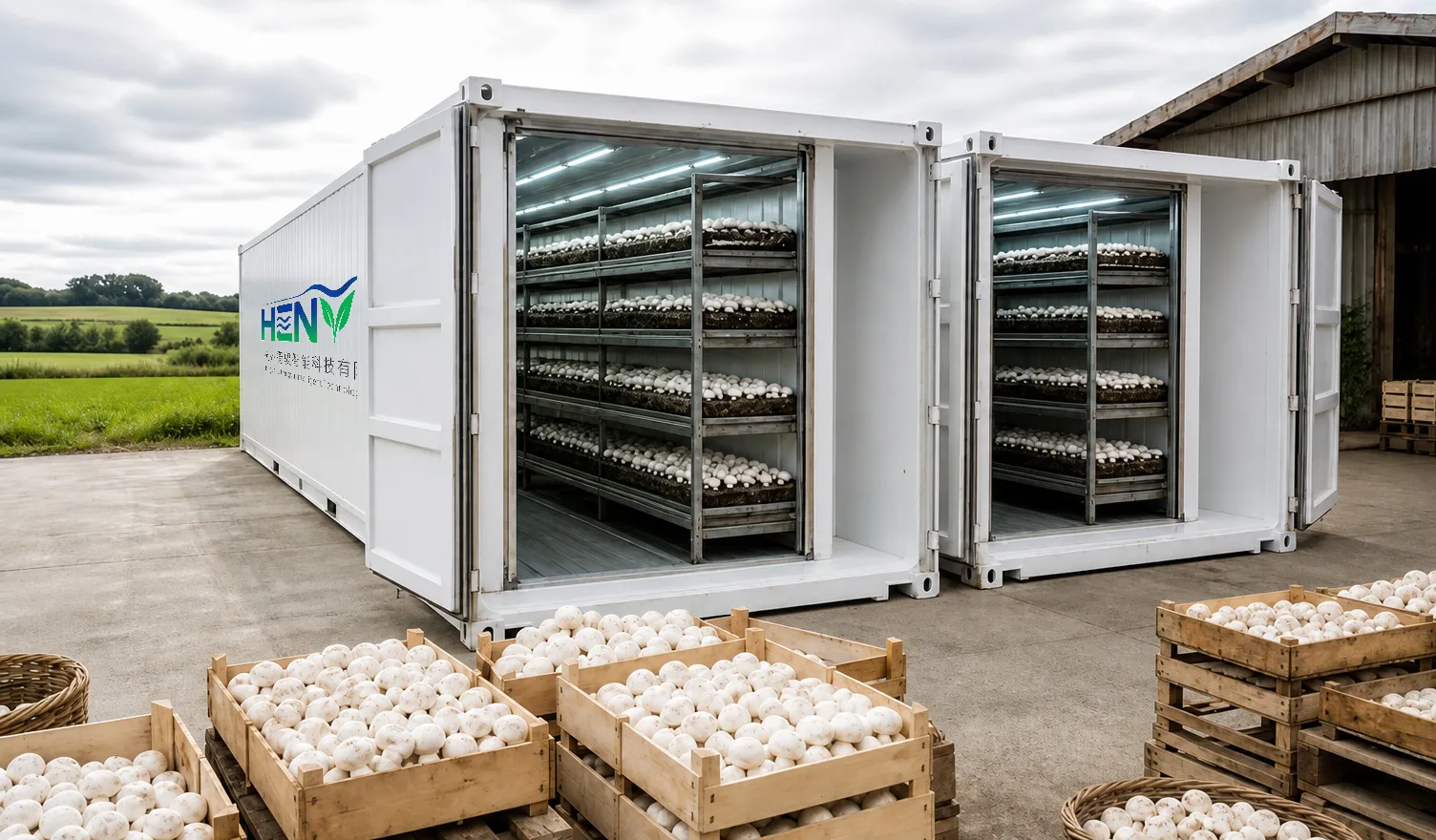
This is what makes mushrooms such a natural fit for a sealed container. A shipping container is not merely a building that happens to hold fungi; it is an instrument for delivering those signals with a precision that a conventional barn cannot touch. Every one of its environmental levers is under digital control, and every lever matters. This article is about how a sealed box coaxes each mushroom to fruit.
The Two Lives of a Fungus
To understand container fruiting technology, it helps to separate the mushroom's life into two distinct phases — because they demand opposite conditions.
Vegetative growth (the spawn run) is the phase of invisible expansion. The mycelium — the white, threadlike body of the fungus — spreads through its substrate, digesting it and storing energy. This phase wants warmth (22–25 °C), high carbon dioxide (often 5,000–20,000 ppm), and darkness. CO₂ here is not a problem to be removed; it is a signal that keeps the fungus focused on growing rather than reproducing.
Reproductive growth (fruiting) is the phase of visible flowering. Having stored enough energy, the mycelium must now be convinced to build fruit bodies. And convincing it means reversing nearly every condition that suited the first phase.
A container farm is essentially a machine for executing that reversal on command — a controlled "shock" that flips the fungus from growth to reproduction, then holds the fruiting environment steady for days until harvest.
The Four Signals of Fruiting
The fruiting trigger is not one switch but four, applied together. Different species weight them differently, but nearly all cultivated mushrooms respond to some combination of the following.
Temperature drop. A sudden reduction in temperature — typically 5 to 10 °C cooler than the spawn-run window — is the classic fruiting shock. Oyster mushrooms fruit around 15–20 °C, lion's mane at 18–22 °C, shiitake near 15–20 °C. Fast, precise cooling is essential, which is why refrigeration capacity is a design constraint rather than an afterthought. It is also why a container needs to manage the fungus's own metabolic heat: a densely colonized block generates warmth and can push a chamber past its setpoint.
Fresh air and falling CO₂. This is the most misunderstood signal and the one most often mishandled. During spawn run the chamber is CO₂-rich and closed; as fruiting begins, the CO₂ level must fall — often dramatically, toward 400–800 ppm for oyster mushrooms. The reason is morphological. High CO₂ suppresses the development of caps and elongates the stems, producing the telltale "leggy" mushroom with a long stalk and a tiny, useless cap. Driving CO₂ down forces compact, well-formed fruit bodies. Because fresh air also carries away moisture and heat, ventilation cannot be managed in isolation; it must be balanced moment by moment against refrigeration and humidification.
High humidity. Fruiting demands the air stay saturated — typically 85 to 95 % relative humidity. Pins and fruit bodies have no water-conserving skin of their own worth mentioning; if the air is dry, they either abort or crack. Ultrasonic foggers, high-pressure misting, and steam humidifiers hold that moisture, with humidity sensors driving continuous feedback control. Excess, however, invites bacterial blotch and wet rots, so the target is a narrow band rather than simply "as wet as possible."
A trace of light. Mushrooms need very little light — but not none. A photoperiod of roughly 8 to 12 hours at low intensity, often 50–200 lux, acts as a morphological signal rather than an energy source. Blue-rich light shapes cap color, stem length, and the direction in which the fruit body grows. It is a compass, not a fuel.
Orchestrating the Sequence
The real artistry of a container farm lies not in holding steady conditions but in moving between them with discipline. A typical batch cycles through clearly defined stages.
Colonization runs 10 to 21 days in the dark, warm and CO₂-rich, until the mycelium has fully permeated the substrate and turned the block into a solid white mass.
Cold shock and fresh-air induction then invert the environment. Temperature falls, ventilation opens, CO₂ drops, light fades in. Within days, thousands of tiny primordia — the "pins" — appear at the block surface. This is the moment the whole enterprise turns on: pin initiation is where consistency is won or lost, because an uneven shock produces an uneven flush.
Fruiting and maturation follow over roughly 4 to 10 days. The pins develop into mature mushrooms, and the chamber holds temperature, humidity, CO₂, and light steady through the flush. The container's job is now to stay boring — no swings, no microclimates, no drift.
Harvest is by hand, and the cycle repeats. A well-managed block typically yields two to three flushes, with the first flush carrying the highest quality and volume.
Why the Box Beats the Barn
Conventional mushroom farms use large, dedicated growing rooms, and they work well. But a container has structural advantages for precision fruiting.
Small sealed volume, fast response. A container holds a fraction of the air of a barn-sized room, so temperature, humidity, and CO₂ can be changed quickly and accurately. The environmental "shock" is sharper, the pins are more uniform, and the grower has finer command.
Sealed against contaminants. Contamination — especially green mold (Trichoderma) and bacteria — is the mushroom grower's greatest loss. A closed, air-filtered, positive-pressure container, entered through an airlock, dramatically reduces the odds of a competitor taking hold.
Species separation. Different mushrooms want different recipes, and a container is a self-contained recipe. Multiple units can run lion's mane, oyster, and shiitake side by side without any of them compromising the others' climate.
A reproducible program. Because the box is sealed, the same protocol delivers the same result in a warehouse in Rotterdam or a lot in Nevada. Fruiting becomes a repeatable program rather than a seasonal gamble.
Precision as a System, Not a Sensor
It is tempting to think of container fruiting as a matter of buying good sensors and a good controller. In practice, precision is a whole-system property.
Substrate preparation determines whether the mycelium has the nutrition to fruit at all. Hygiene determines whether a flush succeeds or is lost to mold. Cooling capacity determines whether a temperature shock can be delivered when needed. Ventilation design determines whether CO₂ can fall fast without dumping heat and humidity. Sensor placement determines whether the controller sees the conditions the mushrooms actually experience — not the conditions at the exhaust vent.
Every one of these is a variable that either supports or defeats the fruiting program. A sealed container is a mechanism for keeping them all inside their windows at the same time.
The Economics of a Perfect Flush
Consistency is not only an aesthetic goal; it is the business. Uniform flushes mean predictable harvest dates, steady labor scheduling, and reliable delivery to restaurants and retailers who buy on a weekly rhythm. Premium buyers pay a premium precisely for reliability.
Against that, energy dominates the operating cost. Refrigeration, humidification, and ventilation run continuously, and a mushroom container may draw tens of kilowatts. Cold climates add heating load; warm climates add cooling load; and the fungus's own metabolic heat must be removed in both. Many operators co-locate with food-waste or agricultural sites to recover waste heat, which can then be reused for substrate pasteurization. Capital cost ranges widely — from roughly 200,000 for a fully automated, multi-zone system with cleanroom inoculation.
The bottlenecks, however, are rarely mechanical. They are biological: contamination control, strain selection, and substrate consistency decide outcomes more than the climate hardware itself.
Sustainability and Circularity
Container mushroom farming sits naturally inside a circular food economy. It consumes residues that would otherwise be wasted — hardwood sawdust, straw, coffee chaff, spent brewer's grain, agricultural and forestry by-products — and returns spent substrate as a nutrient-rich soil amendment, animal feed ingredient, or feedstock for biogas and insect farming. Because production can be local, transport emissions shrink and supply chains shorten.
Conclusion
A container farm does not make mushrooms grow by feeding them — it makes them grow by signaling to them. The sealed box is a device for delivering temperature, humidity, carbon dioxide, and light in precisely the sequence a fungus reads as "time to fruit." Colonize in the dark and the warmth; shock with cold and fresh air; then hold the chamber steady through the flush and harvest what the signals produced.
The technology is mature. The mushrooms are unforgiving. What separates a profitable container farm from an expensive steel box is the discipline to treat every environmental lever as a lever — and to hold them all in their windows, at once, for every single flush.