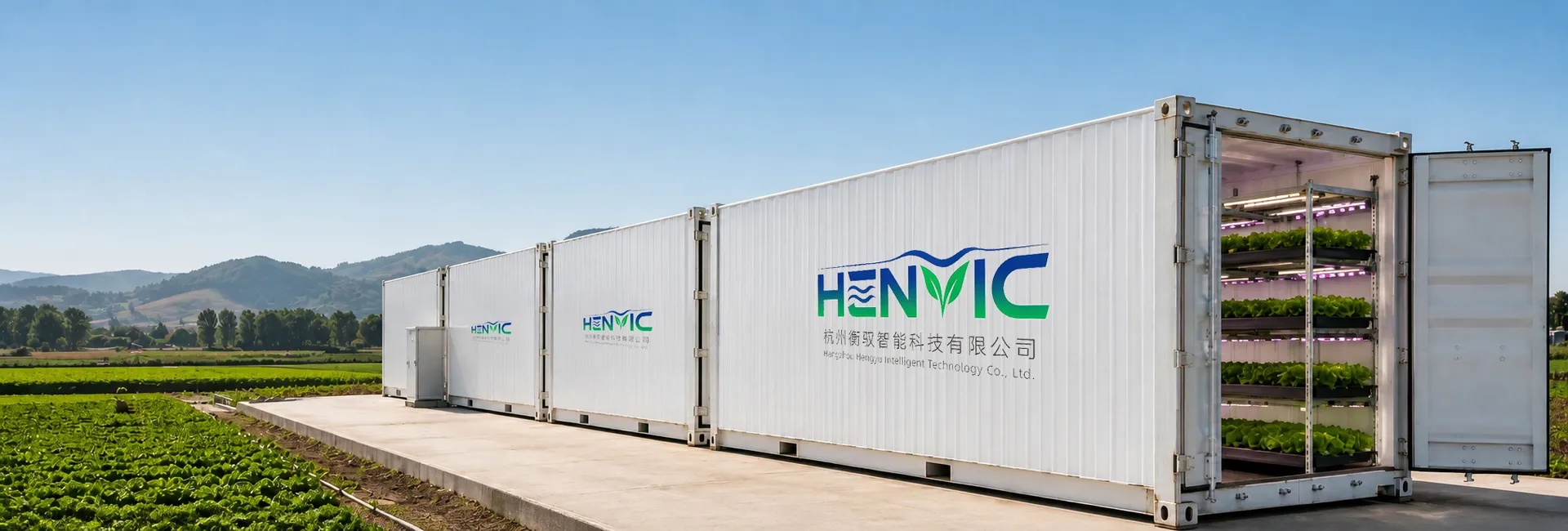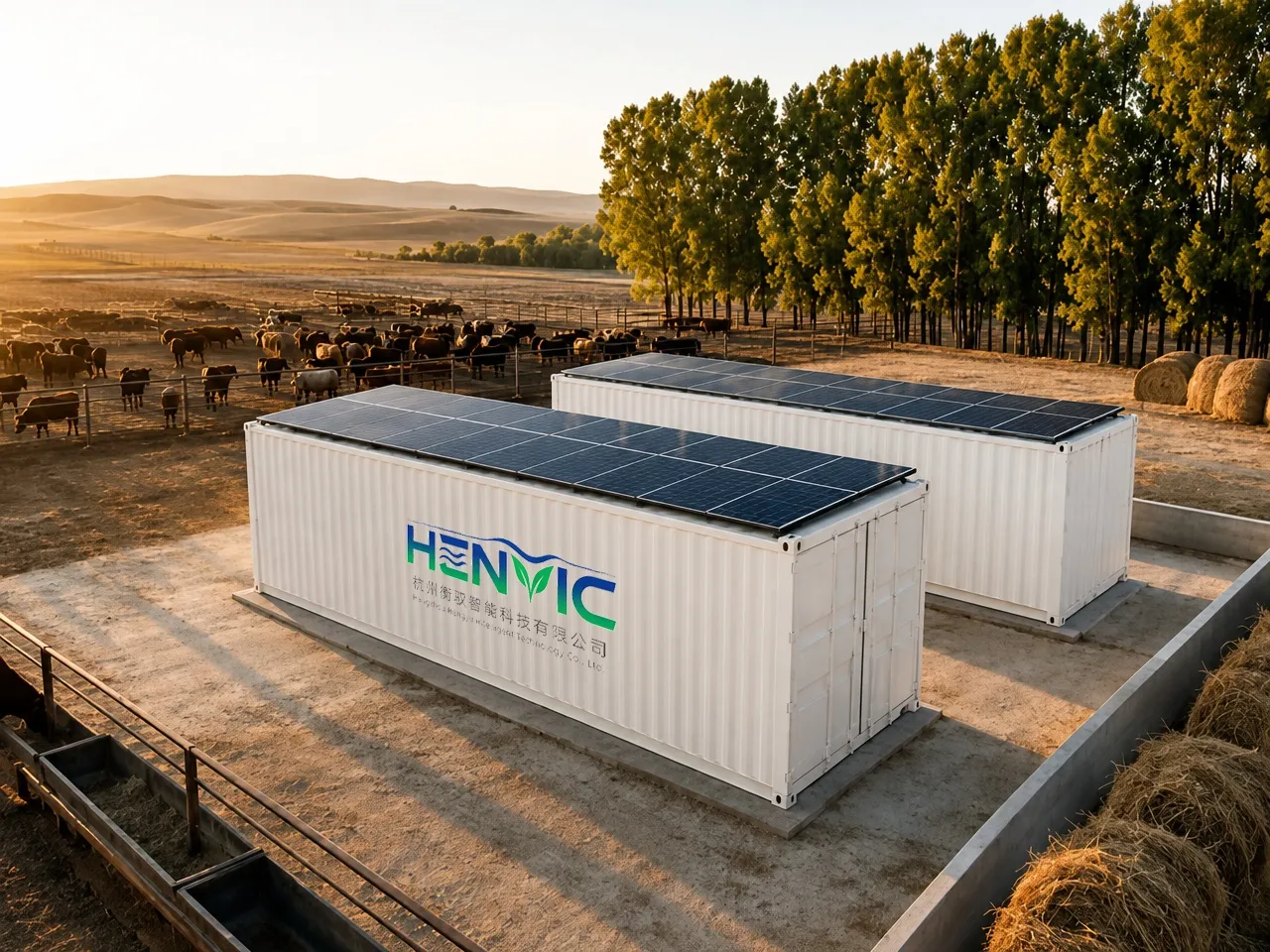
A container farm is, physically speaking, a closed thermodynamic system with no natural ventilation. In an open field or greenhouse, temperature, humidity, and CO₂ largely regulate themselves through air exchange with the outside atmosphere; inside a sealed steel box, nothing regulates itself. Every environmental variable becomes a control variable, and—more critically—these variables are not independent. Cooling removes moisture, dehumidification adds heat, ventilation exchanges CO₂ while destroying the temperature and humidity balance, and airflow is the medium through which all of them are delivered or removed. The environmental control core of a container farm is therefore not four separate loops but one coupled system, and the central design problem is how to manage their mutual interference rather than how to tune each in isolation.
1. Why the Enclosed Box Changes the Rules
The defining constraint is the absence of free air exchange. Without infiltration, the box cannot passively purge heat, moisture, or depleted CO₂; without buffering soil and sky, it cannot damp external swings. This produces two consequences.
First, every disturbance is amplified. The heat released by LED lighting, which in a greenhouse would drift away, accumulates inside the box and becomes the dominant thermal load. The water transpired by the canopy, which outdoors would disperse, saturates the enclosed air and drives up humidity. The CO₂ consumed by photosynthesis is drawn from a finite, sealed reservoir rather than an effectively infinite atmosphere.
Second, the load profile tracks the lighting schedule rather than the sun. Because all light is artificial, temperature, humidity, and CO₂ behavior follow the photoperiod with high predictability—an advantage for control, but also a coupling that makes scheduling decisions in one variable ripple into the others.
2. The Four Variables and Their Coupling
Before treating each variable, it is worth stating the coupling explicitly, because it defines the entire control philosophy.
- Temperature is driven by lighting heat (sensible) plus transpiration (latent). Cooling to remove heat also condenses water, lowering humidity—so temperature and humidity control are physically entangled.
- Humidity rises with transpiration and falls with condensation, ventilation, and dehumidification. Dehumidification by condensation reheats the air; dehumidification by desiccant adds regeneration heat. Both perturb temperature.
- CO₂ is consumed during the light period and released at night, and is replenished by injection or ventilation. Ventilation to control CO₂ or humidity simultaneously discards cooled, conditioned air—an energy cost.
- Airflow is the transport mechanism for all three others. It carries heat to the cooling coil, moisture to the dehumidifier, and CO₂ from injection points to the leaf boundary layer.
Because of this, an adjustment to any one variable inevitably moves the others. The practical consequence is that container farm control is fundamentally a multivariate balancing act, not four independent single-loop controllers.
3. Temperature Regulation
Temperature control in a container farm operates on two levels: air temperature and leaf/canopy temperature.
Air temperature is dominated by the lighting load. High-efficiency LED fixtures convert a large fraction of electrical input into heat, and in a sealed, insulated box this heat has nowhere to go except through the cooling system. The design load is therefore set primarily by fixture power density (W per unit growing area) and the box's insulation quality. Cooling is typically handled by a refrigeration coil with a heat medium distribution loop, and the key performance requirement is uniformity: temperature differences between the top and bottom of the vertical growing stack, and between the supply and return ends, must be minimized to keep crop development even.
Leaf temperature can differ from air temperature and is what actually governs growth and stress. It depends on the balance of absorbed radiation, convective heat exchange, and transpiration. When airflow is low, the leaf boundary layer thickens, convection weakens, and leaves under intense lighting can run several degrees warmer than the surrounding air—raising the risk of heat damage and of crossing the threshold for tip burn or bolting in leafy crops.
This is why temperature cannot be controlled by air temperature alone. The interaction with airflow and transpiration is intrinsic, and the set point must be understood as an air-value proxy for a canopy condition.
4. Humidity and the Centrality of VPD
Humidity in a sealed box is governed almost entirely by the balance between transpiration (source) and condensation, ventilation, and dehumidification (sinks). Because the box has no infiltration buffer, relative humidity can swing rapidly when lighting turns on or off, and it can approach saturation at night when transpiration continues while the cooling coil may be less active.
The practical control metric, however, is not relative humidity but vapor pressure deficit (VPD)—the difference between the saturation vapor pressure at the current temperature and the actual vapor pressure. VPD integrates temperature and humidity into a single quantity that directly reflects the driving force for transpiration. A low VPD (cool, humid air) suppresses transpiration and can lead to calcium deficiency, tip burn, and edema as water accumulates in the leaf; a high VPD (warm, dry air) drives excessive transpiration, causing wilting and stomatal closure that in turn limits CO₂ uptake and photosynthesis.
VPD control is where the coupling becomes unavoidable. Because VPD depends on both temperature and humidity, the correct humidity set point is not fixed—it must be repositioned as temperature changes across the day/night cycle. A control system that holds relative humidity constant while temperature rises will inadvertently push VPD into the stress range.
A second humidity concern is leaf-surface condensation. In a closed box, cool surfaces (walls, coil, glazing) and localized low-airflow zones can fall below the dew point, producing liquid water on leaves—an ideal condition for fungal disease. This risk is managed not by dehumidifying the whole box aggressively but by maintaining airflow and a small VPD margin sufficient to keep the leaf surface above the dew point.
5. CO₂ Management
In a sealed environment, CO₂ is a consumable resource. During the light period, photosynthesis draws down the internal concentration, and without replenishment the box can drop below ambient atmospheric levels—a condition that directly limits growth, since photosynthesis under adequate light is often CO₂-limited rather than light-limited.
Management takes two forms. The first is enrichment: injecting CO₂ to elevate the internal concentration above ambient, which increases photosynthetic rate and, when light and nutrients are not limiting, accelerates biomass accumulation. The target concentration is bounded above by crop tolerance—excessive CO₂ can be harmful and is wasteful—and the cost of supply.
The second is nighttime behavior: without light, photosynthesis stops and respiration releases CO₂, so internal concentration rises overnight. Control logic must account for this cycle rather than treating CO₂ as a constant set point, and the makeup supply should track the diurnal drawdown pattern.
CO₂ also sits at a control conflict with humidity and temperature. The traditional greenhouse remedy for high humidity or CO₂ depletion is ventilation—bringing in fresh air. In a container farm, ventilation defeats the purpose of the enclosed, conditioned environment: it expels cooled air, admits unconditioned humid air, and can introduce pests and pathogens. This is why container farms tend to favor recycling CO₂ enrichment plus mechanical dehumidification over ventilation, accepting higher equipment cost in exchange for preserving the controlled atmosphere.
6. Airflow as the Integrating Medium
Airflow is the one variable that is not an objective in itself but the mechanism by which the other three are realized. Its design requirements follow directly from the couplings described above.
Heat transport. Air must carry sensible heat from the canopy and fixtures to the cooling coil at a rate sufficient to hold temperature within the set range. Insufficient airflow produces thermal stratification—a persistent gradient from top to bottom of the tier stack—and hot spots near high-intensity fixtures.
Boundary-layer management. Leaf-level airflow thins the boundary layer, strengthening convective heat and mass exchange. This affects both leaf temperature and transpiration, which means airflow directly modifies VPD at the leaf surface. Too little airflow and the canopy overheats and stagnates; too much and mechanical stress and excessive transpiration result.
Uniformity. In a multi-tier stack, the airflow distribution is the hardest part. A single pass of air through the whole box cannot penetrate every tier evenly; the lower tiers and interior racks tend to become dead zones. Practical systems therefore use cross-through flow per tier or independent per-tier circulation, so that each level receives equivalent air exchange. Uniform CO₂ delivery, humidity control, and temperature control all depend on this uniformity—making airflow distribution the foundation on which the other three variables rest.
Dew-point control. Adequate and uniform airflow prevents the low-velocity pockets where condensation and disease originate. Airflow is thus a disease-management tool as much as a physiological one.
7. Integration: Why the Loops Cannot Be Separate
The recurring theme is that these four variables form a coupled control problem, and treating them as independent loops produces instability and wasted energy. A few examples make the point concrete.
- Lowering the temperature set point to reduce heat stress increases the latent removal by the cooling coil, drying the air and raising VPD—which may then require humidification, adding load back.
- Dehumidifying to control VPD releases heat, raising temperature and lowering VPD again—a partial self-cancellation that efficient control must anticipate rather than fight.
- Ventilating to replenish CO₂ throws away conditioned air and disturbs both temperature and humidity.
- Increasing lighting for yield raises both the sensible heat load and the photosynthetic CO₂ drawdown, simultaneously stressing the temperature and CO₂ loops.
The mature approach is therefore coordinated control: a supervisory layer that sets temperature, humidity (or VPD), and CO₂ set points together as a function of crop stage and photoperiod, and that accounts for the cross-effects when any single loop acts. VPD is the natural integrating variable for the temperature–humidity pair, and CO₂ scheduling is tied to the lighting cycle.
8. Control Architecture and Sensing
Achieving integration in practice requires a sensing and control infrastructure that can see all four variables and act on their coupling.
The control layer typically includes temperature and humidity sensors distributed at multiple heights and positions (to capture stratification and dead zones), CO₂ sensors placed away from injection points and canopy zones to read representative values, and airflow or differential-pressure instrumentation to verify distribution. Because sensor placement determines what the controller "believes," poor location—such as a CO₂ sensor sitting in an injection plume or a temperature sensor in a stagnant corner—can cause the system to chase a false reading.
Beyond fixed set points, the trend is toward dynamic, stage-aware control: adjusting VPD, CO₂ concentration, and temperature targets as the crop moves from propagation to vegetative growth, optimizing for the physiological demand at each stage rather than holding constant values. Data logging and trend analysis also support fault detection—a gradual decline in achievable temperature uniformity or an unexpected CO₂ drawdown pattern often signals equipment degradation before it produces visible crop damage.
Conclusion
The environmental control core of a container farm is best understood not as four instruments but as one coupled system. Temperature is set by lighting heat and modified by transpiration; humidity is linked to temperature through VPD; CO₂ is a finite resource tied to the photoperiod; and airflow is the medium that delivers and removes all of them. Because adjustments to any one variable propagate into the others, effective control depends on coordinated set-point management—anchored on VPD for the temperature–humidity pair and on day/night scheduling for CO₂—rather than on independent loops. The quality of airflow distribution is the physical foundation on which this coordination succeeds or fails.
It should be noted that the principles discussed here—the sealed-box constraint, the coupling among temperature, humidity, CO₂, and airflow, the role of VPD as an integrative metric, and the trade-off between ventilation and a closed conditioned atmosphere—reflect established understanding in controlled-environment agriculture. Specific set points, target concentrations, VPD ranges, and airflow rates vary considerably with crop species, growth stage, fixture power density, box insulation, tier configuration, and equipment selection. Actual control parameters should be determined from crop-specific physiological requirements, equipment specifications, and empirical commissioning data for the particular system, and this article provides a framework for understanding and organizing environmental control rather than set-point values for any specific installation.